
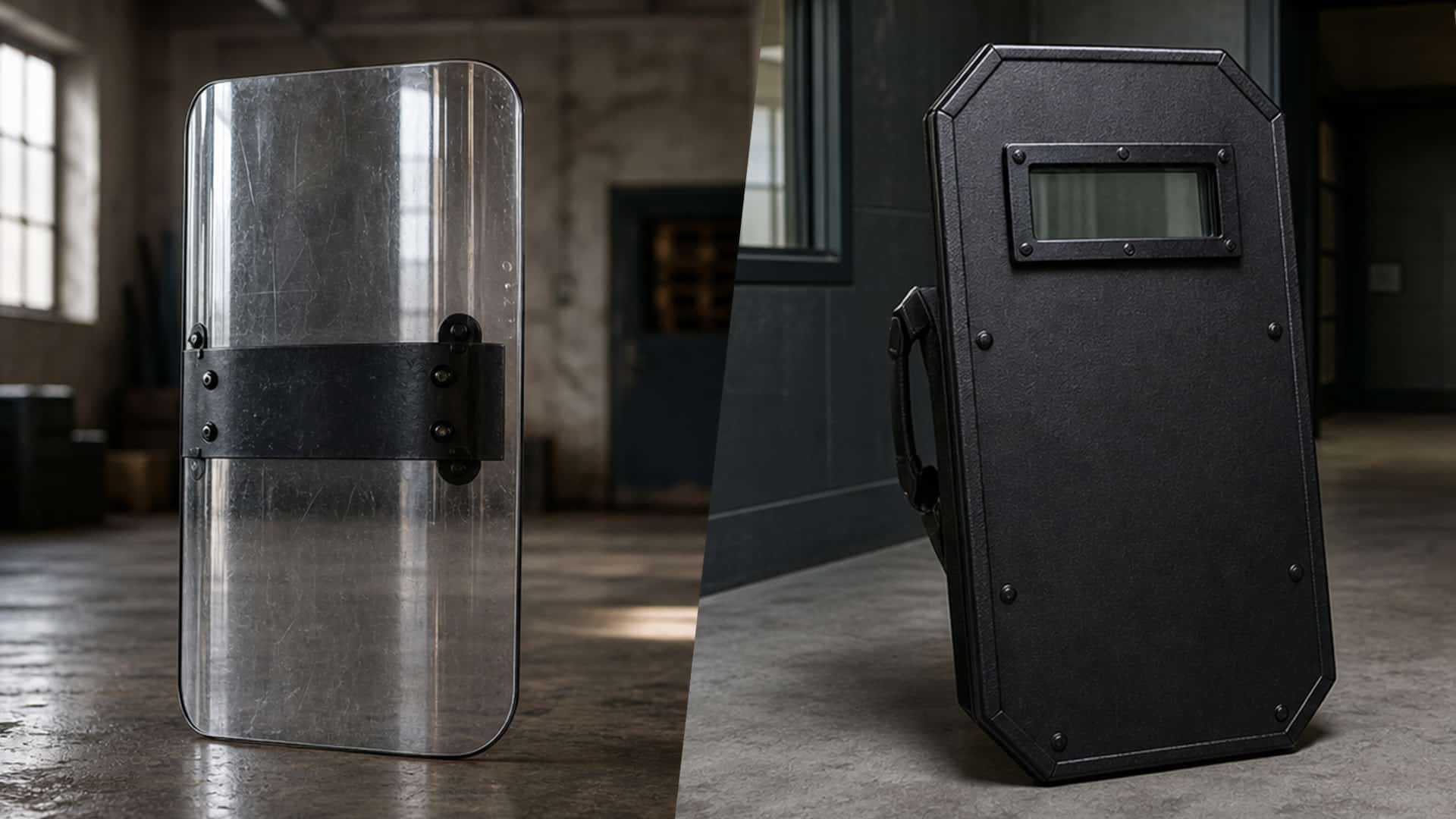
Riot shields and ballistic shields get confused all the time. They both look like protective shields, and both show up around police, security teams, or emergency response personnel.
Most riot shields aren’t bulletproof. They’re generally built for crowd control, impact protection, and stopping thrown objects or physical contact. Ballistic shields are a different category entirely, built to resist specific ballistic threats under tested conditions.
If your facility’s evaluating protective equipment for a school, courthouse, hospital, government building, or security checkpoint, you need to know what each type of shield is actually built to do before you make that call.
Are Riot Shields Bulletproof?
In most cases, no. Standard riot shields aren’t bulletproof.
A riot shield’s built for crowd management and impact protection, serving as a physical barrier against thrown objects, crowd pressure, blunt impacts, and physical contact. They’re often designed to be light enough to carry and clear enough to see through, which makes them useful in crowd-control situations, especially when visibility, mobility, and impact resistance matter more than stopping gunfire.
Impact protection isn’t the same as ballistic protection, though. A shield can be strong enough to resist certain blunt impacts and still not be built to stop bullets. That’s why it’s risky to assume a riot shield offers bullet-resistant protection unless it’s specifically tested and rated for that. If the concern is firearm protection, a standard riot shield isn’t the right category to lean on. That’s where ballistic shields come into the picture.
“Bulletproof” gets thrown around a lot, but “bullet-resistant” is usually the more accurate term. Ballistic protection depends on a shield’s rating, materials, design, and the type of threat it was actually built to address.
Riot Shield vs. Ballistic Shield: What’s the Difference?
The biggest difference between a riot shield and a ballistic shield comes down to what each one’s designed to resist.
A riot shield is mainly built for impact protection: crowd control, thrown objects, physical contact. A ballistic shield is built for bullet-resistant protection, and whether it stops a given round depends entirely on its rating. A mobile ballistic shield takes that same ballistic protection and makes it portable, giving facilities or teams movable coverage instead of a fixed barrier.
Not all ballistic shields protect against the same risks, a shield might be built for certain threat levels but not others, so review the shield’s actual rating and intended use before assuming what it can do.
Can Ballistic Shields Stop Rifle Rounds?
Some ballistic shields are built to resist certain rifle threats.
That comes down to the shield’s ballistic rating, materials, thickness, weight, design, and intended use. Higher levels of ballistic protection generally need stronger, heavier materials, which affects how a shield gets moved, stored, and used as part of a facility’s response plan.
Instead of asking whether a shield is “bulletproof,” ask what specific threats it is rated to resist. No protective product should be treated as protection against every possible threat.
If your facility’s comparing protection levels, Iron Badger’s guide to UL 752 standards explains how bullet-resistant products are rated and tested at a high level.
When Would a Facility Need a Ballistic Shield Instead?
A ballistic shield enters the picture when impact protection isn’t enough and bullet-resistant protection is part of the facility’s safety plan. That may include schools with emergency response needs, courthouses, government buildings, healthcare facilities, guarded checkpoints, and other public-facing spaces where fixed barriers don’t cover every risk.
Choosing the right solution comes down to understanding the difference between crowd-control equipment and ballistic-rated protection for your facility’s specific risks, not which one sounds more protective.
How Mobile Ballistic Shields Fit Into Layered Security
A ballistic shield isn’t the whole security plan. It’s one tool within a broader approach.
A layered security plan typically includes:
- Controlled entrances
- Visitor management
- Reinforced glass
- Secure doors
- Door security devices
- Access control
- Emergency communication
- Staff procedures
- Mobile ballistic shields
Each layer does a different job. Bullet-resistant glass protects fixed openings. Bullet-resistant doors protect key access points. Door security devices secure rooms or interior spaces. Mobile ballistic shields can provide movable coverage in areas not protected by fixed barriers.
The right combination depends on the building, the people inside, and the risks the organization’s trying to address. For a school, that might mean entrances, classroom doors, and emergency response procedures. For a courthouse, it might mean public checkpoints and secured staff areas. For a healthcare facility, it might mean public entrances, reception areas, and security team response needs.
The best plan starts with understanding the actual environment.
Frequently Asked Questions
Are riot shields bulletproof?
Most riot shields aren’t bulletproof. They’re generally built for crowd control, impact protection, and stopping thrown objects or physical contact. If you need bullet-resistant protection, a rated ballistic shield is the category to look at instead.
Would a riot shield stop a bullet?
You shouldn’t assume so. Unless a shield’s specifically tested and rated for ballistic protection, it shouldn’t be treated as bullet-resistant.
What can a riot shield withstand?
Certain impacts, thrown objects, pushing, and other crowd-control hazards, depending on its materials, construction, and intended use.
Are ballistic shields bulletproof?
They’re built to resist specific ballistic threats under tested conditions. “Bulletproof” isn’t really an absolute term, so it’s more accurate to say a ballistic shield may be bullet-resistant based on its rating and design.
Can ballistic shields stop rifle rounds?
Some are rifle-rated, but not all ballistic shields are. It depends on the shield’s rating, materials, design, and the threat level it was built to address.
Not Sure Which Type of Protection Your Facility Needs?
Riot shields and ballistic shields aren’t the same thing, and knowing the difference matters more than picking whichever one sounds more protective. A riot shield’s built for crowd control and impact protection. A ballistic shield’s built for bullet-resistant protection against specific threats, depending on its rating and design.
If you’re not sure whether your facility needs impact protection, ballistic protection, or both, a professional security assessment can help evaluate your risks, response needs, and current safety plan.
Iron Badger Defense Solutions serves facilities throughout Missouri, including Jefferson City, Springfield, and Cape Girardeau, and can help assess your security needs and recommend practical protective solutions based on your facility’s layout, risk level, and operational goals.
Contact Iron Badger Defense Solutions at (573) 301-0097 to schedule a security assessment.