
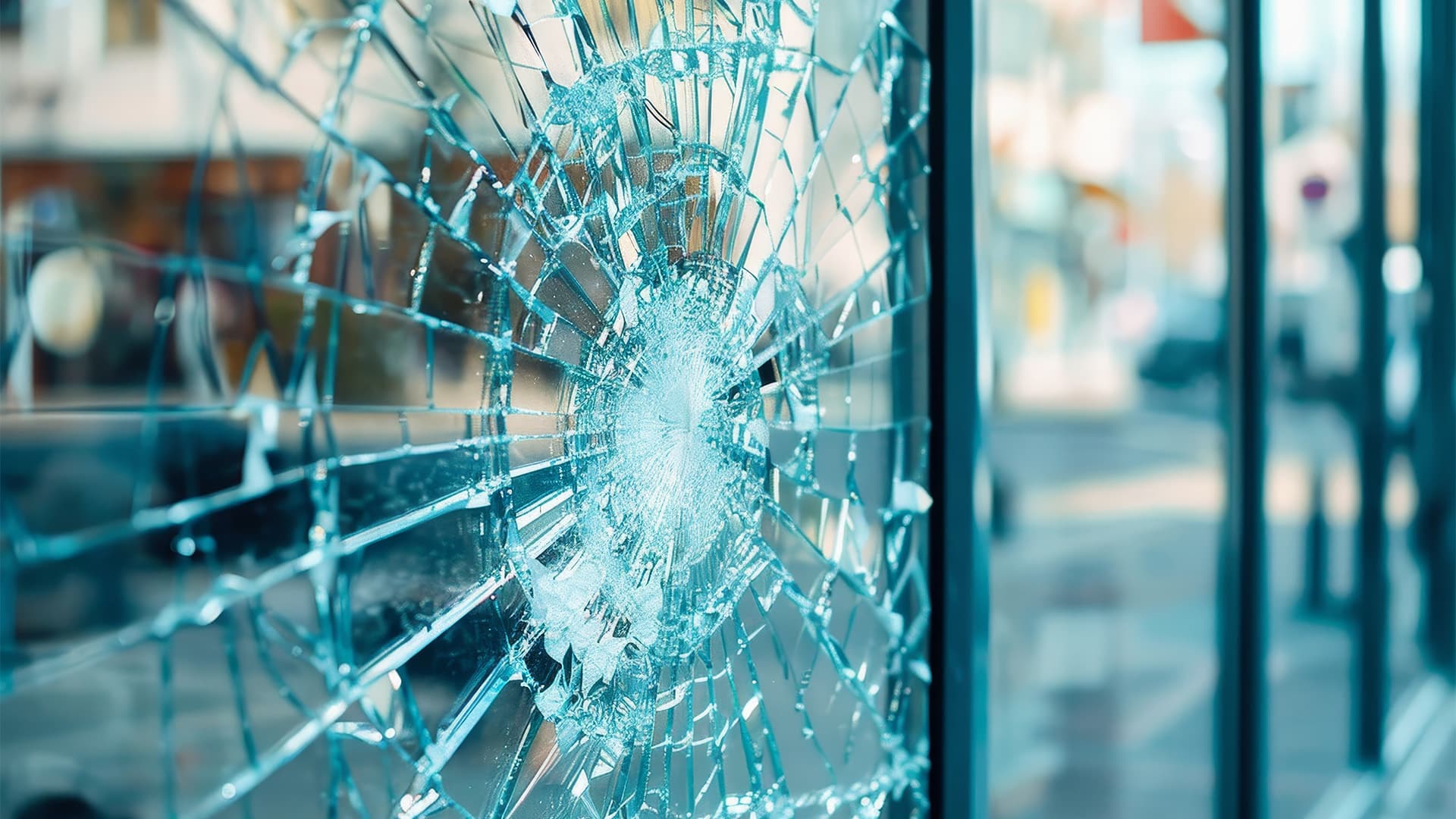
Window security film is often associated with improved security, especially in schools, healthcare facilities, and commercial buildings. But when terms like “security film,” “bullet-resistant window film,” and “ballistic window film” are used, it can create confusion about what level of protection it actually provides and whether window film is truly bulletproof.
Understanding how window film performs and where its limits are is essential when evaluating whether it meets the needs of your facility.
Quick Answer – Is Window Film Bulletproof?
No, window film is not bulletproof. It is not intended to stop ballistic threats or provide the same level of protection as specially engineered bullet-resistant glass systems.
Window security film is designed to help hold broken glass together and, in many cases, can help delay forced entry. Its performance depends on the type of film, the thickness, the installation method, and the kind of impact involved.
What Window Security Film Actually Does
Window security film is a protective layer applied to glass to improve how that glass performs when it is struck or broken. In many cases, it is used to reduce shattering, keep broken glass in place, and improve resistance to certain types of forced entry.
That matters because broken glass can create serious safety issues on its own. Glass fragments can injure building occupants, and once glass breaks, entry may become easier.
Window security film is often used in places like:
- schools
- office buildings
- retail storefronts
- healthcare facilities
- government buildings
In these settings, window security film may help improve safety and glass retention. But it is still important to understand that window security film is not designed to stop bullets.
Does Window Security Film Stop Bullets?
Window security film does not stop bullets and is not designed to provide ballistic protection. While it can help hold shattered glass together and may improve resistance to impact or forced entry, it does not perform like bullet-resistant glass systems.
Window security film may help reduce hazards from broken glass and, under certain conditions, can help delay entry after impact. However, stopping a firearm threat requires materials and systems that are specifically engineered and tested for ballistic performance.
Understanding this difference helps prevent a common assumption: that making glass harder to break is not the same as making it resistant to bullets. These are two very different levels of protection.
How Strong Is Window Security Film?
Window security film can be strong in ways that differ from bullet-resistant solutions. For example, window security film may help with:
- shatter resistance by helping broken glass stay together
- glass retention by reducing how far shattered pieces spread
- forced-entry delay by making it harder to break through quickly
Glass treated with window security film is more resistant to breakage than untreated glass. In many cases, it may require more time, more force, or repeated impacts to break through.
What Window Security Film Can and Cannot Do
| Feature | Window Security Film |
| Holds shattered glass together | ✅ Yes |
| Helps delay forced entry | ✅ Yes |
| Reduces glass fragmentation | ✅ Yes |
| Stops bullets | ❌ No |
| Provides ballistic rating | ❌ No |
Window security film can improve how glass behaves after impact, but it does not turn standard glass into bullet-resistant glass.
That difference matters for facilities trying to make informed safety decisions. If the concern is break-in delay, glass retention, or reducing injury from shattered glass, film may be worth evaluating. If the concern is firearm protection, a different level of solution is usually required.
Is There Such a Thing as Bullet-Resistant Window Film?
The idea of “bullet-resistant window film” can be misleading. While window security film can improve how glass behaves after impact, it is not designed to provide ballistic protection.
True bullet-resistant systems are engineered as complete glazing assemblies. They are built with multiple layers, specialized materials, and specific installation methods that are tested to meet defined performance standards.
Window security film, by comparison, is intended to improve glass retention and may help delay certain types of forced entry. It does not provide the same level of protection as materials designed to stop ballistic threats.
Understanding this distinction is important when evaluating security options. While window security film can play a role in improving safety, it is not a substitute for bullet-resistant glass.
Why Window Film Is Often Mistaken for Bulletproof
There are a few reasons this misconception is so common.
First, window security film can make glass behave very differently when struck. Instead of shattering immediately into loose pieces, the glass may stay in place and look more secure.
Second, terms like “security film,” “ballistic film,” or “bulletproof window film” can sound stronger than they really are. For someone researching quickly, those phrases can suggest a level of protection the product is not actually intended to provide.
Third, while strength is a term used for a variety of security products, the type of strength can vary. A product may be strong against shattering or forced entry, but still not provide a barrier to ballistic threats.
When Window Security Film May Be Appropriate
Window security film may be appropriate when the goal is to improve glass safety without fully replacing existing glazing.
In many cases, it makes sense for:
- reducing glass fragmentation after breakage
- helping hold shattered glass together
- delaying certain types of forced entry
- improving safety in retrofit situations
- adding another layer to a broader security plan
For some schools, offices, storefronts, and similar facilities, those benefits may be meaningful. The right fit depends on the building, the risks being considered, and the level of protection required.
A helpful way to think about it is this:
- If your goal is glass retention or break-in delay, window security film may be worth evaluating.
- If your goal is protection from gunfire, window film is not enough.
- If your building has a higher-risk profile or needs tested protection levels, a professional assessment is the better next step.
Pairing Other Safety Solutions with Window Security Film
Some environments require more security than what is provided by window security film on its own. In higher-risk settings, decision-makers may need to consider bullet-resistant glass systems instead.
That may apply when:
- firearm threats are part of the security concern
- the facility needs a higher level of tested protection
- the building serves vulnerable occupants
- security planning must meet specific protection expectations
Bullet-resistant glass is typically part of a broader engineered system. It is not just about the glass itself. Performance may also depend on framing, installation details, and the overall design of the opening.
This is also why it helps to avoid making assumptions based on product names alone. Window security film and bullet-resistant glazing can both play roles in facility protection, but they are not interchangeable.
Professional Assessment and Next Steps
Every facility has different security goals, building conditions, and threat concerns. What may be appropriate for one property may not be enough for another.
That is why the best next step is often not choosing a product right away. It is getting clarity on what level of protection your building actually needs.
Not sure whether window film provides the level of protection your facility needs?
A professional security evaluation can help determine how your existing windows perform and whether solutions such as security film or bullet-resistant glazing may be appropriate for your building.
If your facility is located in Missouri or a surrounding state, Iron Badger Defense Solutions can help evaluate your building’s security and recommend appropriate protective solutions based on your specific needs, with regular service in Jefferson City, Springfield, and Cape Girardeau.
Frequently Asked Questions
Is window film bulletproof?
No, window security film is not bulletproof and is not designed to stop bullets. It may help hold shattered glass together and improve resistance to certain impacts, but that is not the same as ballistic protection.
How strong is window security film?
Window security film can be strong enough to reduce shattering, improve glass retention, and help delay forced entry. Its performance depends on the type of film, thickness, installation, and the type of force involved.
Is there a bullet-resistant window film?
Standard window film does not provide true ballistic protection. Products described with phrases like “bullet resistant film” or “ballistic film” may still not perform like engineered bullet-resistant glazing systems.
Can window film improve building security?
Yes, in many cases it can help improve building security by reducing glass fragmentation and delaying certain types of break-ins. However, it should be matched to the right use case and not mistaken for bulletproof protection.